
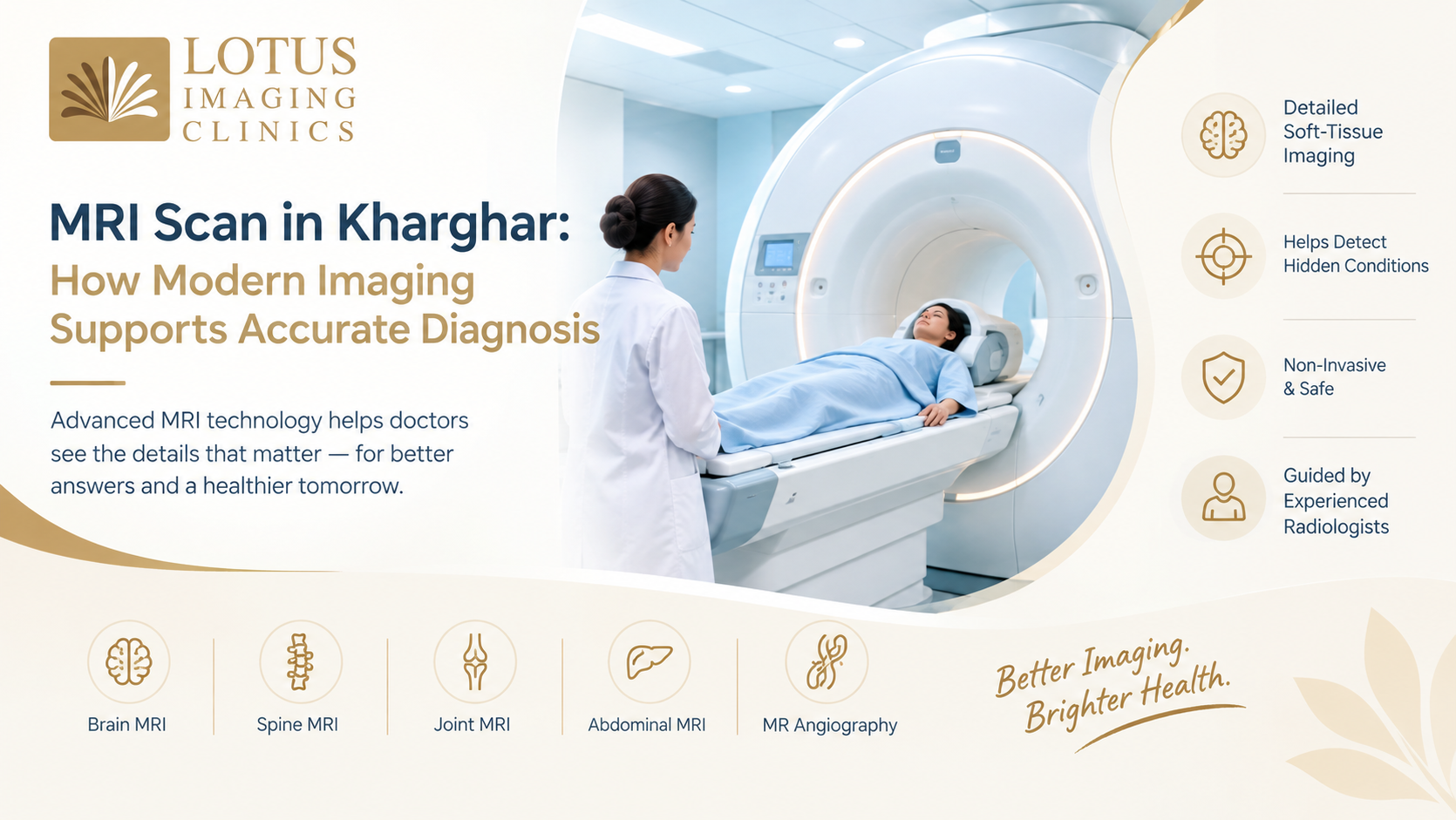
MRI Scan in Kharghar: How Modern Imaging Supports Accurate Diagnosis
When doctors need a detailed view of the brain, spine, joints, internal organs, or other soft tissues, Magnetic Resonance Imaging (MRI) can provide valuable diagnostic information. Unlike imaging methods that use ionising radiation, MRI uses magnetic fields and radio waves to create detailed images of the body. Lotus Imaging Clinics provides MRI imaging in Kharghar with radiologist-led reporting and a structured process designed to support referring doctors in diagnosis and treatment planning.
What Is an MRI Scan?
An MRI scan is a non-invasive imaging examination that produces detailed images of different structures within the body. It is particularly useful for evaluating soft tissues such as the brain, spinal cord, muscles, ligaments, cartilage, and certain organs.
For people looking for an MRI scan in Kharghar, the type of examination performed depends on the area being investigated and the reason for the referral. Brain MRI, spine MRI, joint MRI, MR angiography, and other specialised examinations may be recommended according to the patient’s clinical requirements.
Why Is MRI Used for Diagnosis?
One of the important advantages of MRI is its ability to provide detailed soft-tissue images. This can help doctors investigate symptoms and understand abnormalities that may require further evaluation.
An MRI center in Kharghar can support the diagnostic process by providing imaging that doctors can consider alongside the patient’s symptoms, medical history, physical examination, and other investigations. MRI may be recommended for concerns involving the brain, spine, joints, muscles, ligaments, or selected internal organs.
The examination itself does not provide a diagnosis independently. Instead, the images are interpreted by a qualified radiologist, and the findings are documented in a report for the referring doctor.
What Happens During an MRI Scan?
Patients searching for an MRI scan in Kharghar may be unsure about what happens during the procedure. Before the examination, the imaging team generally confirms the prescribed scan and provides any necessary preparation instructions.
Safety screening is an important part of the process. Patients may be asked about metallic implants, pacemakers, previous surgeries, metal fragments, or other factors that could be relevant to MRI safety. It is important to provide accurate information during this screening.
During the examination, the patient lies on a movable table that gradually moves into the MRI scanner. The machine captures images through a series of sequences. Remaining still during the examination helps produce clearer images.
Some MRI scans may involve contrast material when specifically required by the referring doctor or radiologist. Whether contrast is needed depends on the clinical question and the type of examination.
How Should You Prepare for an MRI?
Preparation varies depending on the type of MRI being performed. Some examinations may require specific instructions regarding food or drink, while others may not require any special preparation.
Patients should follow the instructions provided by the imaging centre and bring their prescription or referral details. It is also important to inform the imaging team about implants, medical devices, pregnancy, allergies, previous surgeries, or any other relevant information before the scan.
Patients who feel uncomfortable in enclosed spaces can also discuss their concerns with the imaging staff beforehand. Knowing what will happen during the examination can make the experience easier to manage.
Choosing an MRI Center in Kharghar
When selecting an MRI center in Kharghar, patients can consider several practical factors, including the imaging equipment, radiologist reporting, patient guidance, safety procedures, accessibility, and report turnaround time.
Lotus Imaging Clinics provides diagnostic imaging services in Kharghar, including MRI. The centre’s MRI service is intended to support doctors in evaluating different medical conditions through detailed imaging.
A well-organised imaging process can help patients understand the examination requirements and ensure that the relevant information reaches the radiologist. This is particularly useful when the MRI is being performed as part of an ongoing diagnostic evaluation.
MRI Compared With Other Imaging Tests
MRI is one of several imaging methods used in modern healthcare. The most suitable test depends on the symptoms, suspected condition, body area being examined, and the information required by the treating doctor.
For certain clinical situations, a CT scan in Kharghar may provide useful information through detailed cross-sectional images. In other cases, ultrasound may be appropriate for examining specific organs and tissues.
This means that an MRI scan in Kharghar should not automatically be considered the appropriate examination for every condition. The referring doctor and radiologist can determine which imaging method is relevant to the clinical requirement.
The Role of Radiologists in MRI Reporting
Producing high-quality images is only one part of diagnostic imaging. The images must also be reviewed and interpreted carefully. A radiologist examines the MRI images and prepares a report describing relevant findings.
For someone choosing an MRI center in Kharghar, understanding the importance of radiologist reporting can be helpful. The report gives the referring doctor additional information that can be considered when deciding on further evaluation, treatment, or follow-up.
At Lotus Imaging Clinics, MRI services are part of a broader diagnostic imaging setup intended to support patients and referring doctors during the diagnostic process.
Frequently Asked Questions
1. Is an MRI scan painful?
MRI is generally a non-invasive examination. Patients need to remain still while images are being captured, and the scanner can produce loud sounds during different stages of the examination.
2. How long does an MRI scan take?
The duration depends on the type of scan and the body area being examined. Some examinations may be relatively short, while more detailed studies can take longer.
3. Does an MRI use radiation?
MRI uses magnetic fields and radio waves rather than ionising radiation. However, patients should always complete the required safety screening before the examination.
4. Can everyone have an MRI?
Not necessarily. Certain implants, devices, metal fragments, or other circumstances may require additional assessment before an MRI. Patients should provide complete information during the safety screening.
5. Do I need a doctor’s referral for an MRI?
The need for a referral depends on the examination and clinical situation. A doctor’s referral can provide the radiologist with important information about the symptoms or condition being investigated.